The Art of Protest – Beiträge
English Version below
Wenn Mittel gekürzt werden, wächst der Widerstand, aber auch die Solidarität. Wenn Räume enger werden, werden Stimmen lauter. Mit THE ART OF PROTEST eröffnet 3 TAGE FREI seine komprimierte Ausgabe mit einer vielstimmigen Revue aus künstlerischen Interventionen, Reden und diskursiven Momenten.
Die Freie Tanz- und Theaterszene Stuttgart gUG (FTTS) hat im Rahmen eines Open Calls Künstler*innen aus Baden-Württemberg eingeladen, performative Beiträge zu entwickeln: pointiert, präzise, maximal acht Minuten lang. Gesucht wurden Arbeiten, die Protest nicht nur thematisieren, sondern als künstlerische Praxis begreifen – als Haltung, Risiko, Zuspitzung und solidarische Geste.
Entstanden ist ein Abend, der sich an der politischen Tradition der Revue orientiert: schnelle Wechsel, starke Bilder, humorvolle Brechungen, poetische Verdichtungen. Zwischen Grußworten und Festivalauftakt, Musik- und Wortbeiträgen, entfaltet sich eine Abfolge kurzer performativer Setzungen – laut und leise, analytisch und emotional, widerständig und verletzlich. Protest erscheint hier nicht als Parole, sondern als ästhetische Strategie.
Die folgenden sieben Beiträge – vier aus Stuttgart, drei aus Baden-Württemberg – bilden gemeinsam eine kollektive Eröffnungsgala. Die Auswahl erfolgte per Losverfahren und macht die Vielfalt der Freien Darstellenden Szene sichtbar.
THE ART OF PROTEST ist kein Beiwerk, sondern Auftakt: ein sichtbares Zeichen dafür, dass Kürzungen nicht zu weniger Kunst führen müssen – sondern zu mehr Zusammenhalt, mehr Erfindungskraft und mehr Dringlichkeit. Ein Abend, der zeigt, dass Protest eine Kunst ist. Und Kunst ein Protest.
Stuttgart
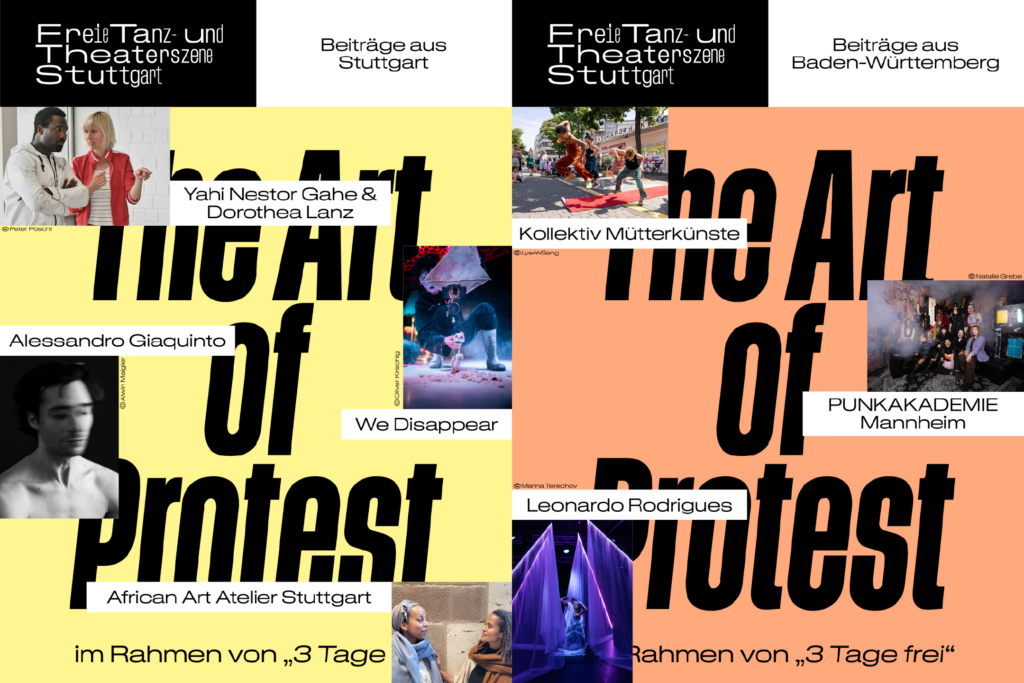
- Yahi Nestor Gahe & Dorothea Lanz
In »Le Vide« begegnet Tanz der Sprache und Sprache dem Tanz. Die Bewegung ist dabei stetig. Leere. Menschen verstummen. Sie schweigen. Volles Schweigen – entleertes Schweigen. Monströs ist, wofür man keine Worte mehr findet. Widerstand braucht Halt im Kollektiv.
- Alessandro Giaquinto
Der in Stuttgart lebende Choreograf und Performer Alessandro Giaquinto arbeitet zwischen Tanz, Performance und Schreiben. Bei The Art of Protest zeigt er »NULL«, ein reduziertes Solo über die radikale Geste der Stille.
- Ronja Schweikert, Micha Schlüter, Viktoria Kasprik //
We Disappear
Husch husch, sind die fort? Drei Künstler*innen suchen mit Musik, dem Tod und einem Staubsauger nach der (Auf)lösung. Ein absurder, poetischer Protest gegen das Unsichtbarwerden, das Verschwinden und das Auflösen von Identität.
- Dahab Paulos & Muna Hassaballah // African Art Atelier Stuttgart
»Ubuntu. Ich bin, weil Du bist.« Wie sieht eine Welt aus ohne Kunst und Kulturarbeit? Und was bedeutet das für Werte wie Gemeinschaft, Menschlichkeit und Mitgefühl?
In Zeiten der Zersplitterung, sowie Kürzungen für Kunst und Kultur ist Zusammenhalt und gegenseitiges Empowerment nicht nur eine Notwendigkeit, sondern auch ein Akt des Weiterlebens. In dieser Performance macht das African Art Atelier Stuttgart die afrikanische Philosophie Ubuntu erlebbar: über Performances, Storytelling und neuen Gedanken, wie es weiter gehen kann….
Baden-Württemberg
- PUNKAKADEMIE Mannheim
Drei Akkorde. Widerstand. Flinta* ins Rampenlicht! Das ist die PUNKAKADEMIE Mannheim, ein Projekt der freien Musiktheatergruppe glanz&krawall und dem Stadtensemble des Nationaltheaters Mannheim. Laut, mit Wut und Solidarität.
- Kollektiv Mütterkünste
Willkommen im öffentlichen Raum, welcome to the Underground Company, ihre Begleitgesellschaft für sichere Wege und aufrechte Haltungen.
Das intersektional feministische Kollektiv Mütterkünste beschäftigt sich mit gesellschaftspolitischen Themen und bearbeitet diese künstlerisch. We take care.
- Leonardo Rodrigues
Leonardo Rodrigues begegnet dem Tanz als einer Alchemie aus Spannung, Rhythmus, Stille und Energie, in der sich kulturelle Erinnerung über die Zeit in Schichten im Körper ablagert. In »Re:Befreiung« wird der sich verwandelnde Körper zum Protest. Wenn Prekarität hier neu erscheint – was kann von Körpern gelernt werden, die seit Generationen damit leben?
[EN]
When funding is cut, resistance grows – but so does solidarity. When spaces become tighter, voices grow louder. With THE ART OF PROTEST, 3 TAGE FREI opens its condensed edition with a polyphonic revue of artistic interventions, speeches and discursive moments.
As part of an open call, the Freie Tanz- und Theaterszene Stuttgart gUG (FTTS) invited artists from Baden-Württemberg to develop performative contributions: pointed, precise and no longer than eight minutes. The call sought works that do not merely address protest as a theme, but understand it as an artistic practice – as a stance, a risk, a form of intensification and a gesture of solidarity.
The result is an evening inspired by the political tradition of the revue: rapid transitions, striking images, humorous ruptures and poetic condensations. Between welcoming speeches and the festival opening, musical and spoken contributions, a sequence of short performative statements unfolds – loud and quiet, analytical and emotional, resistant and vulnerable. Here, protest appears not as a slogan, but as an aesthetic strategy.
The following seven selected contributions – four from Stuttgart and three from across Baden-Württemberg – come together to form a collective opening gala. The works were selected by lottery, highlighting the diversity of the independent performing scene.
THE ART OF PROTEST is not an add-on but a beginning: a visible sign that funding cuts do not have to mean less art – but can lead to greater solidarity, greater inventiveness and greater urgency. An evening that shows that protest is an art. And that art is a protest.
Stuttgart
- Yahi Nestor Gahe & Dorothea Lanz
In »Le Vide«, dance encounters language and language encounters dance. The movement is continuous.
Emptiness. People fall silent. Complete silence—emptied silence. Monstrous is that for which one can no longer find words. Resistance needs support in the collective.
- Alessandro Giaquinto
Stuttgart-based choreographer and performer Alessandro Giaquinto works across dance, performance and writing. At The Art of Protest he presents »NULL«, a stark solo reflecting on the radical gesture of silence.
- Ronja Schweikert, Micha Schlüter, Viktoria Kasprik //
We Disappear
Hush hush, are they gone? Three artists search for (dis)solution using music, death, and a vacuum cleaner. An absurd, poetic protest against becoming invisible, disappearing, and dissolving identity.
- Dahab Paulos & Muna Hassaballah // African Art Atelier Stuttgart
»Ubuntu. I am because You are.« What does a world without art and cultural work look like? And what does that mean for values like community, humanity, and compassion? In times of fragmentation and cuts to art and culture, solidarity and mutual empowerment are not only a necessity but also an act of survival. In this performance, the African Art Atelier Stuttgart brings the African philosophy of Ubuntu to life: through performances, storytelling, and new ideas about how to move forward…
Baden-Württemberg
- PUNKAKADEMIE Mannheim
Three chords. Resistance. Flinta* into the spotlight! This is the PUNKAKADEMIE Mannheim, a project by the independent music theatre group glanz&krawall and the city ensemble of the Nationaltheater Mannheim. Loud, with anger and solidarity.
- Kollektiv Mütterkünste
Welcome to public space, welcome to the Underground Company, your companion organization for safe paths and upright stances. The intersectional feminist collective Mütterkünste engages with socio-political issues and explores them artistically. We take care.
- Leonardo Rodrigues
Leonardo Rodrigues approaches dance as an alchemy of tension, rhythm, silence and energy, where cultural memory accumulates in layers across time. In »Re:Befreiung«, the transforming body becomes protest. If precarity is new here, what can be learned from bodies that have lived it for generations?